

History of building websites, 1 of 10
In the 1990s, you built your web page by hand
Free home pages, tables and invisible pictures: how a teenager in 1996 put her first page online, and what it still teaches you
By Orla Finch ·
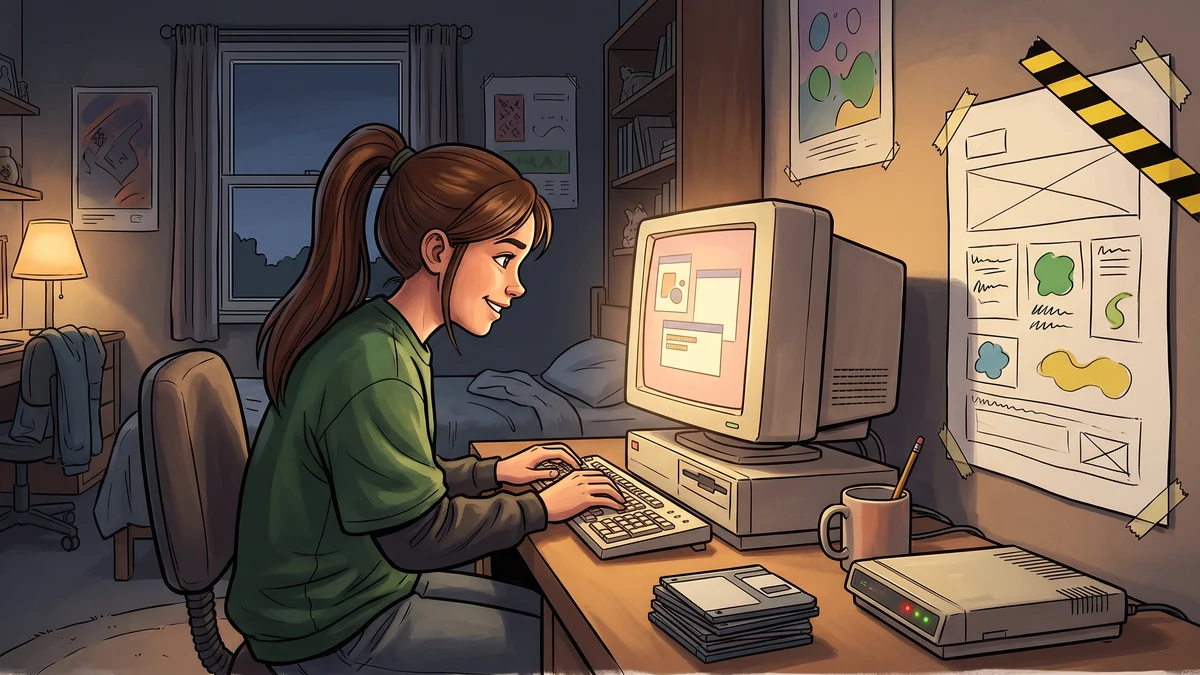
Say it is 1996, and a teenager we will call Jess wants a page about the band she loves. She has no designer and no money to spend. She types it herself, tag by tag, and puts it online for free. This October we are telling the story of how people have built websites, one era at a time, up to November, when Foo's own story begins. Jess is where it starts.
What Jess types is HTML, a set of plain labels, called tags, that tell a browser which words are a heading, which are a paragraph and where a link goes. Tim Berners-Lee, a British scientist working at CERN in Switzerland, proposed the web in 1989. He wrote HTML down in late 1990, along with the first browser. The first public description of its tags came out in late 1991, and it listed 18 of them.
Before 1993, most browsers were heavy on text, with no settled way to show pictures beside the words. Then Marc Andreessen and Eric Bina made the Mosaic browser, and that changed.
Jess's page needs a home, and she can have one for free at GeoCities. David Bohnett and John Rezner started it in November 1994. From mid-1995 it handed out free home pages with 2 MB of space. Its members were called Homesteaders, and each one chose a neighborhood: pages about entertainment went in Hollywood, pages about computers in SiliconValley. A street number made each address unique.
It grew fast. It signed up its millionth Homesteader on October 2, 1997. Yahoo! bought it in January 1999, close to the height of the dot-com boom. By then GeoCities was the third most visited site on the web, behind AOL and Yahoo! itself.
Then comes the hard part: making the page look the way Jess wants. HTML tables were meant for rows and columns of data. Designers found they could use them to lay out a whole page in columns, which HTML could not otherwise do. It worked, but the pages were fragile and hard to manage.
Empty table cells could collapse to nothing, so people filled them with a spacer GIF: a tiny picture you could see through, often saved as spacer.gif. You could not size a table cell directly, but you could set a picture's width and height to whatever you liked, and the cell would stretch to hold it. The same invisible image could fill every gap on the page. The first book known to print the trick is Creating Killer Web Sites, by David Siegel, from 1996.
The trick had a cost. A page could look perfect on the screen it was made on and different on someone else's, with another screen size, browser or font setting. Changing a design built this way was tedious work.
The way out was already coming. The W3C, the group that sets web standards, brought in CSS in December 1996: a separate set of instructions for how a page looks, kept apart from the words. By around 1998, the spacer trick was out of date for designing pages.
GeoCities did not make it. Yahoo! closed the United States service on October 26, 2009, after at least 38 million pages, most of them made by the people who used it.
What Jess had then is still the point now: a page that is yours, that you made, at an address you can give a friend.